
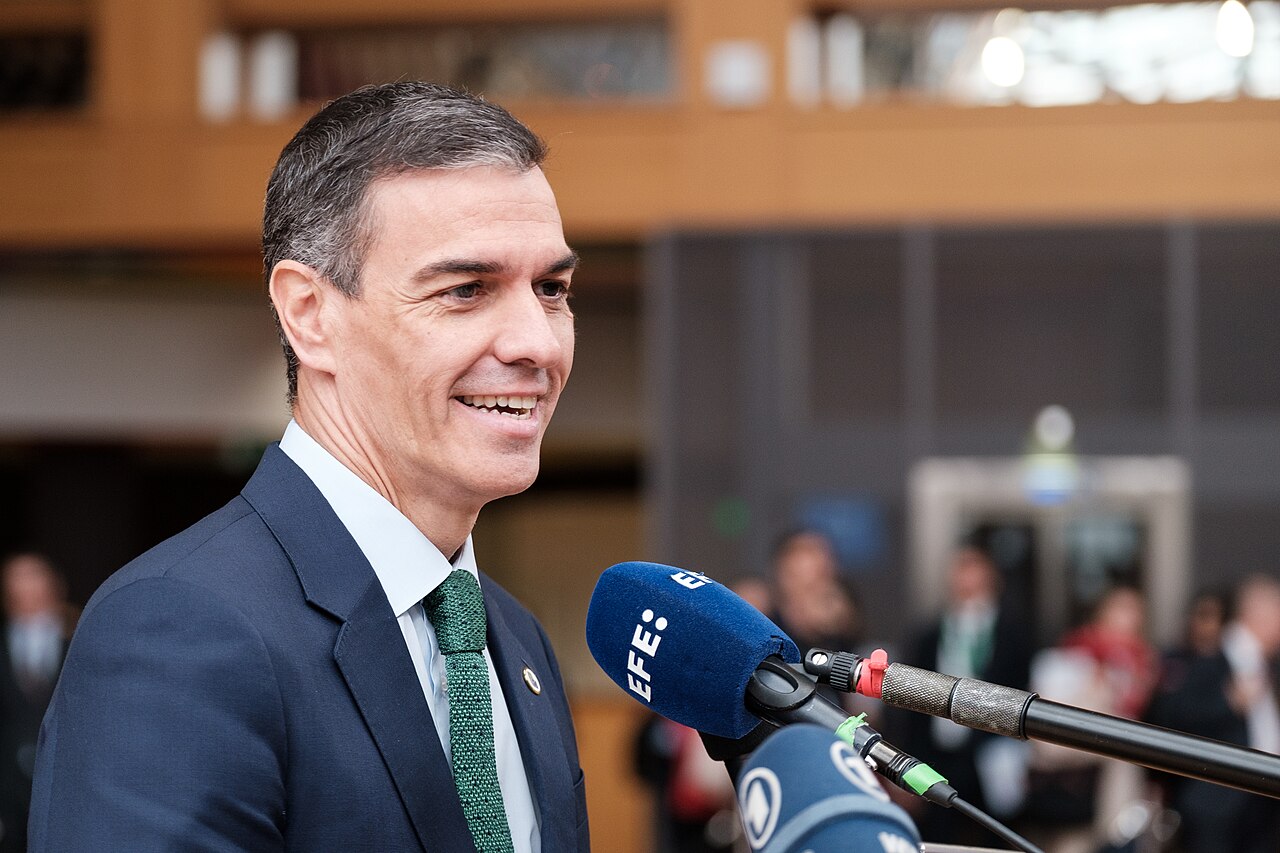
The Spanish region of Aragón held elections on February 8, 2026. Prime Minister Pedro Sánchez’s Socialist Party (PSOE) suffered a major defeat as the conservative People’s Party (PP) gained the trust of 34.3 percent of the electorate. Another great winner is the Vox party with a support of 17.9 percent, almost double of its 2023 results. The PSOE gained 24.3 percent of the votes, losing five seats. Its worst-ever result in the region. PSOE’s local candidate Pilar Alegría summarized the disappointment with, ‘this is not the result we wanted’.
It shouldn’t have come across as a surprise, though. With Sánchez’s shrinking popularity and all the corruption scandals engulfing him, his closest associates, and his party. All proving to be liabilities for candidates at the municipal and regional levels. In fact, there are at least four reasons why the PSOE is unworthy of the trust of the electorate.
No. 1. Sánchez’s family
For a Prime Minister who positioned himself as an anti-corruption hero following the disastrous governance of conservative PM Mariano Rajoy, Sánchez is in a precarious position. Members of his closest family have been involved in several corruption cases.
Starting with his wife, Begoña Gómez. She was involved in several interlinked cases, all centred around tourism company Globalia.
One such case involved a bailout of Air Europa (Globalia’s subsidiary) out of budget funds. Investigative reporters found that Gómez was involved in the negotiations over the bailout, that is now under scrutiny for at least ten irregularities. Later, reporters discovered that Gómez had a close relationship with Globalia’s former CEO, Javier Hidalgo. In fact, Hidalgo created the company Wakalua. Said company later ended up sponsoring IE Africa Center (running different development programs in African countries), directed by no other but Gómez. Gómez is accused of influence peddling. Providing letters of recommendation to private companies which later gained contracts from public companies or the state itself.
Another case Begoña Gómez was involved in is the Complutense Case: though she doesn’t have a university degree, she took part in establishing and leading a chair at Complutense University in Competitive Social Transformation. Gómez has run two master’s programs with substantial public sector involvement. Eleven ministries and several public companies have provided sponsorship or support. The accusations against her are the same: embezzlement, influence peddling and misuse of public resources.
Sánchez’s brother is another black sheep in the family.
David Sánchez faces trial for alleged malfeasance and influence peddling. He’s accused of collaborating with the Socialist leadership in the Extremadura region and creating a public post specifically tailored for him. He’s also accused of living in Portugal in order to avoid Spanish taxes.
No. 2. Government members involved in corruption
Taking a step further away from the prime minister – one can find the same level of corruption. Or worse.
In fact, the anti-corruption champion was forced to change course and declare that there was no such thing as ‘zero corruption’, when one of his closest associates was brought down in an escalating corruption scandal in the summer of 2025. That time it was the secretary of the PSOE Santos Cerdán, who is accused of improperly awarding public contracts in exchange for kickbacks.
But Cerdán wasn’t the first or the last high ranking party official involved in corruption. Sánchez’s former transport minister, José Luis Ábalos is the central figure of a series of intertwined corruption cases; along with Koldo García, his advisor. Ábalos is Sánchez’s long-time political ally. He was a key figure in the PSOE until his eventual fall. The earliest reports emerged in 2020, yet Sánchez chose to Ábalos for another year. Then, removing him from the helm of the ministry didn’t mean that Ábalos lost his influence: he remained in the Congress of Deputies. He remained the chair of the Interior Commission.
In one case, a whopping €1.64 billion was involved in illegal transactions: bailouts of private companies, misuse of pandemic-related funds (to purchase masks and other health equipment). Procurement procedures were bypassed, favours were handed out – and a shell company (Management Solutions) was created in Zaragoza so it could be awarded three large government contracts, in a total value of €40.5 million.
A network of corruption with tentacles in every corner of the government.
Koldo García also leveraged his political connections to ensure that a business services firm received multiple contracts totaling approximately €54 million. The so-called Hydrocarbons Case also has Ábalos in the centre. This time he received a villa in Cádiz, favors for his mistress and cash in return for giving a hydrocarbon operator licence to Víctor de Aldama. This time, the Treasury lost €180 million in VAT.
No. 3. Corruption cases and other illegal acts in the wider PSOE
Spain’s top prosecutor is appointed by the government, Thus the government shares the blame when said official turns to be corrupt.
That is the case of Attorney General Álvaro García Ortíz, who was found guilty of leaking confidential information related to a tax fraud case on November 20, 2025. A first in Spanish history, no sitting attorney general faced criminal investigations before.
The court barred him from public office for two years. Yet, he started to work at the Labour section of the Supreme Court Prosecutor’s Office. Probably not surprising given that the PSOE closed ranks around the attorney general even during the trial. Sánchez himself declared that he ‘believed in his innocence’. Another PSOE heavyweight, Francisco Salazar is not just any former senior official: he’s a close Sánchez ally. A real embarrassment for the prime minister as he’s right now accused of sexual harassment. He reportedly made ‘inappropriate comments about a female subordinate’s clothing and body, invited her to dinner alone and asked her to sleep at his home’.
Not the first and probably not the last party official whose name got connected to allegations of sexual misconduct, harassment and assault or at least inappropriate behaviour towards women. To make it worse, the party’s leadership has repeatedly ignored the warnings and complaints then later blamed the failure on ‘computer error’. Two other names linked to inappropriate behaviours are the already mentioned José Luis Ábalon and Koldo García. Secret recordings prove talks about prostitutes, mistresses and other sexual misconduct.
No. 4. The PSOE’s proven inability to govern Spain
As though the corruption engulfing every level of the party wouldn’t be enough. It’s paired with the complete lack of professional governance capabilities.
While there are some positive developments (like falling levels of unemployment and a slight improvement in the fiscal situation), there are severe lingering structural weaknesses: productivity is infamously low and regional development is uneven.
The country’s energy dependence is a huge vulnerability. As it was proved by the major blackout on April 28, 2025, that plunged Spain and Portugal into darkness for about ten hours – causing widespread disruption in telecommunications, transportation and emergency services. The causes are still being determined, but the event highlighted the inherent problems of Spain’s energy network concerning grid stability and external dependency.
In 2023, Spain recorded an energy dependency rate of 68 percent. Higher than European average of 58 percent. The high level of import fossil fuels exposes Spain to price volatility and supply crises.
The tragedy also highlighted another misguided approach. While the government invested billions of euros into renewables, critical infrastructure across the country is in dismal state. Let it be in the energy sector or transportation. Andalusia and Catalonia both have experienced several episodes of short- and medium duration outages triggered by substation failures or grid anomalies. Just like its bureaucracy, the country’s healthcare system is overburdened. Both in terms of physical capacity and staff in spite of the promised health spending.
The housing situation is dire. Public construction is rising thanks to regulatory intervention, yet rents and affordability pressures still squeeze the population. Rental prices have risen 58 percent, while house prices by 42 percent since 2015. The crisis is particularly severe for the under 30 population, with only 15.9 percent of young people living with their parents. The average age at which people leave their parents’ home is now at 29.5 years. The high prices make it increasingly unaffordable for young people to move out. The crisis is deepened by low wages and legal uncertainty.
The latest in the list of misguided government actions is the hasty decision to grant legal status to 500,000 illegal immigrants. A step that clearly violates not only the trust of the country’s allies, but is also against the opinion of 57 percent of the Spaniards, who consider that immigration levels are ‘too high’.
Against this background it’s less surprising that the Vox party is attracting voters from Sánchez’s PSOE.
The latest polls predict (and the elections in Aragón foreshadow) that Sánchez is the weakest link in the chain. The PSOE is at 26.5 percent and loses support mainly to the conservative parties. Castile and León go to the polls on March 15. It’s yet to be seen whether enough voters changed their opinions about the Prime Minister and his corruption-ridden party.