
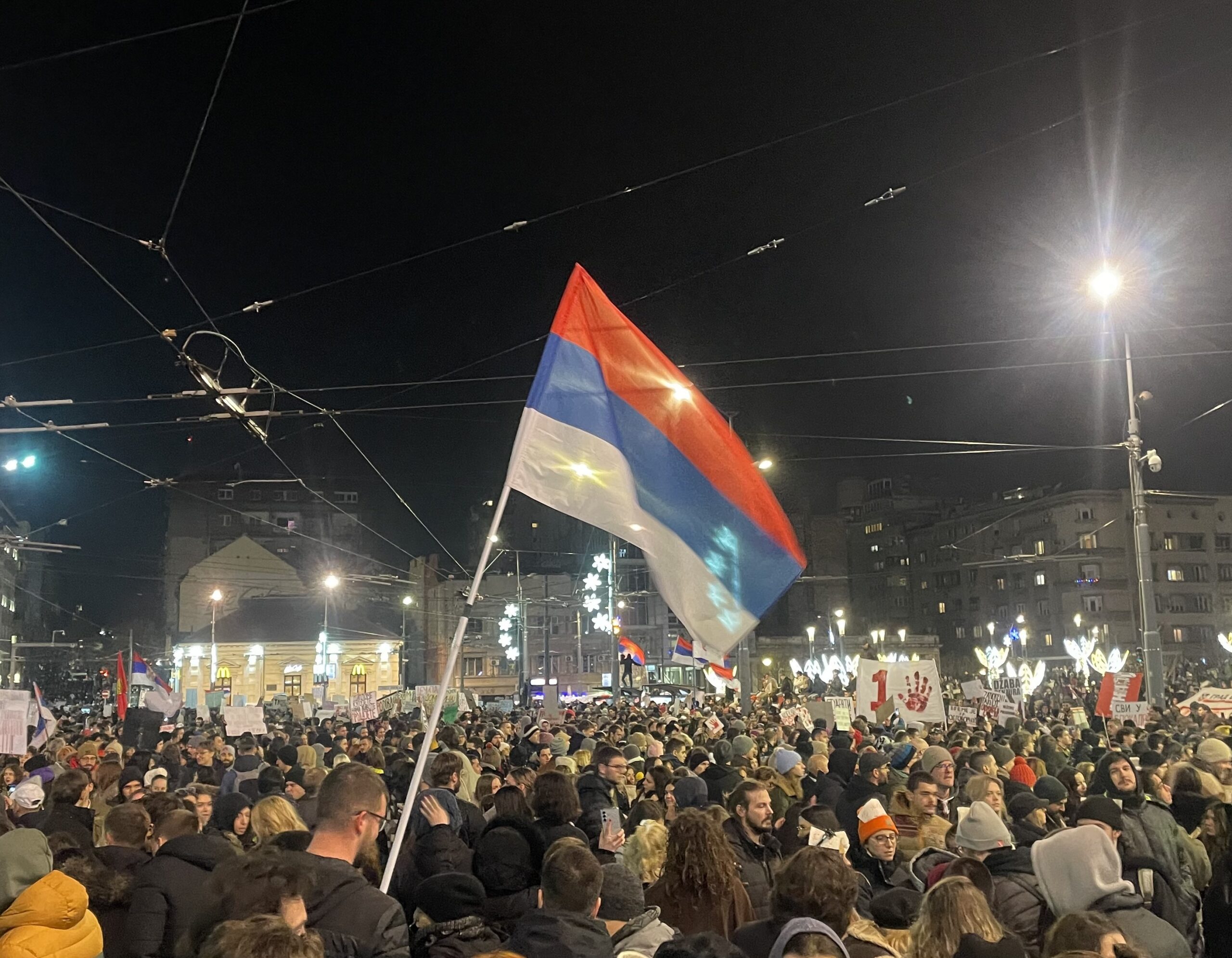
The media coverage is extensive.
News agencies from all over the world (including heavyweights like The Guardian, CNN or Euronews) reported widely on the election victory of the grassroots, student-backed “Student List” (Studentska lista) in Serbia’s snap parliamentary elections.
The historic results ended the 14-year dominance of Aleksandar Vučić and his Serbian Progressive Party (SNS). (Before the quick burial, it’s worth keeping in mind that it remained the second political force in Serbia anyway. The defeat is a far cry from what Hungary’s former governing party suffered, for example.)
According to the Republic Electoral Commission (RIK), after voting was repeated at 53 polling stations on 1 November, the Student List won 53.0% of the votes cast and 140 of the 250 seats, giving them legislative power to pass fundamental reforms, but no two-thirds majority.
A Coalition, Not A Party
To complicate matters, the Student List is not a standard political party or movement. It is an election coalition without any shared political ideological background. The single unifying thing was the target: ousting the Vučić regime. The other, somewhat lofty goals included structural, non-partisan governance, strict anti-corruption initiatives, rebuilding democratic institutions, and strengthening the freedom of media.
The Student List does not have an official prime minister candidate.
In fact, it explicitly stated that it was decentralized and leaderless on purpose, hoping to operate without a traditional hierarchy. Rather than selecting a single figure to front the campaign, candidate selection was handled through open assemblies (plenums).
What might seem like political naivety from an outsider point of view, was, in fact, a brilliant strategy during the campaign when the lack of “visible”, central figures made it more difficult to the incumbent regime to target individuals. The government might have had the complete security (and financial) apparatus under its thumb, there was no well-defined enemy.
It also served as a clear point of differentiation between the Vučić regime’s and the opposition’s leadership models.
Fourteen Years of the Vertical State
As a reminder – for over a decade, Serbia was run under a hyper-centralized, vertically integrated system. Every major decision—from multi-billion-dollar foreign investments down to local municipal issues—went through Vučić himself as the state functioned around a single strongman.
The Student List wanted to prove that it can be done differently.
After 14 years of Vučić’s strong handed, centralised governing, they promise a different approach, with transparent decision making and swift action against corruption.
The result was quickly described as “historic”, “seismic” or a “massive political earthquake”. Hopes are flying high (especially across Europe) that a new era arrived in Serbia’s democratic future and its relationship with the EU.
But Serbia’s long-term transformation will depend on whether new leaders can reform institutions and sustain democratic momentum in a region of Europe where history and geographic realities often overwrite even the most enthusiastic changes.
Probably this is why many Western European capitals, though expressing their satisfaction, exercised caution and restraint in their congratulatory messages.
It will be not easy to dismantle what Vučić built – not impossible, but a road full of challenges.
The Four Pillars: Serbia’s Balancing Act
For over a decade, Serbia pursued a policy of “four pillars” of foreign policy (EU, Russia, China, US), trying to balance Western integration with Eastern alliances. The EU is Serbia’s largest economic donor, investor, and trading partner. Serbia officially opened EU accession negotiations in 2014, making Brussels its primary economic destination. Belgrade historically accepted billions in EU funds while simultaneously conducting military drills with Russia, buying Russian arms, and maintaining a visa-free regime with Moscow.
The Serbian-Russian connection is a historical bond, Serbia shares deep cultural, religious (Orthodox Christianity), and Slavic roots with Russia. During the 1990s wars, after the collapse of Yugoslavia and the Western Balkan wars, Russia backed Belgrade and still does it in the crucial Kosovo issue. Russia holds a veto in the UN Security Council and strictly refuses to recognize Kosovo’s independence, making Moscow Serbia’s most vital geopolitical shield over its territorial claims.
Tito’s Ghost: How Balancing Became Doctrine
Serbia’s “sitting on multiple chairs” policy is a modern revival of a historic strategy.
Following the famous 1948 split between Yugoslav leader Josip Broz Tito and Soviet dictator Joseph Stalin, Yugoslavia refused to become a Soviet satellite. Instead, Tito masterfully balanced between the Western bloc and the Soviet Union, extracting economic and military aid from both while co-founding the Non-Aligned Movement. In the 2000s, Serbia formalized this into a doctrine known as the “Four Pillars” of foreign policy (the EU, Russia, the US, and China). The goal was simple: use economic ties with the West while relying on Russia and China for political backing, especially regarding Kosovo.
This strategy was followed by Vučić in the last 14 years.
No wonder the Student List notoriously tried to avoid geopolitical issues during the campaign, focusing on the anticorruption messages instead.
From the small crumbs let known here and there, it can be in fact deducted that their position is fairly similar to Vučić’s in the main foreign policy issues, first and foremost Kosovo. For example, in the lead-up to the campaign, the movement published a formal four-point Memorandum on Kosovo and Metohija. In it, they strictly adhered to the Serbian Constitution, declaring Kosovo an “inalienable and integral part of the Republic of Serbia”.
The same way, NATO is also a hot potato, one the Student List admires from the safe distance of Strict Military Neutrality. The legacy of the 1999 NATO bombing remains deeply emotional and universally unpopular across all political spectrums in Serbia. Within their core 11-point “Student Plan” platform, the Student List explicitly anchored military neutrality as a foundational tenet of their foreign policy. The campaign made it clear that Serbia would not seek NATO membership or move closer to the alliance militarily.
Throughout the election, whenever the regime tried to drag them into a debate over Kosovo or Western alliances, the students aggressively pivoted the conversation back to their core demands: independent courts, media freedom, and strict accountability for state corruption.
The very same reasons that gave birth to the movement – the mass protests over corruption and governance failures (all brought to a tipping point by the Novi Sad station collapse that killed 16 people).
Many experts pointed out that the incoming government is unlikely to entirely abandon the careful geopolitical balancing act that Serbia has maintained for years.
This doesn’t mean that European leaders are wrong when they view the victory of the Student List as a genuine “new chapter”.
It can (and might) shift the entire basis of Serbia’s relationship with the EU from transactional stability to shared values.
With special emphasis and explicit focus on the rule of law and institutional reforms. The Student List offers the EU a chance to work with a transparent, democratically legitimized leadership rather than a transactional strongman. A nice change after Vučić’s decade of democratic backsliding and “state capture”.
As the Student List avoided making the election a polarizing referendum on foreign policy during the campaign to maintain a broad coalition, their voter base is overwhelmingly pro-European. Data shows that 75% of Student List supporters actively want closer ties with the European Union.
This gives the incoming leadership a strong domestic mandate to aggressively pursue European integration without fearing immediate political backlash from their own core voters.
This might help in Brussels – and in Serbia’s immediate neighbourhood.
Vučić’s populist rhetoric frequently led to tense, volatile relations with neighbouring Balkan states. Following the election, leaders from neighbouring countries—such as Montenegro’s Prime Minister Milojko Spajić—publicly welcomed the victory, calling it a turning point for regional stability. For Brussels, a Serbia that behaves as a predictable, cooperative neighbour makes the integration of the entire Western Balkans significantly easier.
Serbia will not do a 180-on foreign policy, ignoring geopolitical reality, historical and cultural backgrounds. Neither is it likely that the Student List will suddenly support sanctions against Russia.
But a new generation of Serbians might find a different way to balance the country’s cultural heritage, geopolitical realities and their desired way of life. They can truly start a new chapter in the history of Serbia, one that is closer to Europe and keeps a greater distance to Moscow.
Other countries in the region might learn the lesson as well. (Well, from Serbia and Hungary.)
Grassroots movements can unseat corrupt administrations.
It takes time (in Serbia, the elections came at the end of nearly two years of student led mobilization, gradually expanding beyond universities), but it can be done. A unified opposition can defeat even high levels of institutional capture or fear. Public anger can be transformed into an organized electoral movement.
In the same manner, Serbia might not turn its back on Russia, but Moscow suffered a serious blow, anyway. It lost a second important ally within a year – more might follow if regional leaders recognize the shift in power. Then, a less Russophile Central and Eastern Europe can alter the course of European foreign policy itself.